Spray pumps and trigger sprayers – what’s the difference?
Spray pumps and trigger sprayers are widely used in cosmetic, household, pharmaceutical and industrial packaging.
Although both dispense liquid in a controlled spray form, their construction and intended use differ significantly.
Understanding the individual components helps select the correct solution for the product, formula viscosity and usage frequency.
Key components of a spray pump
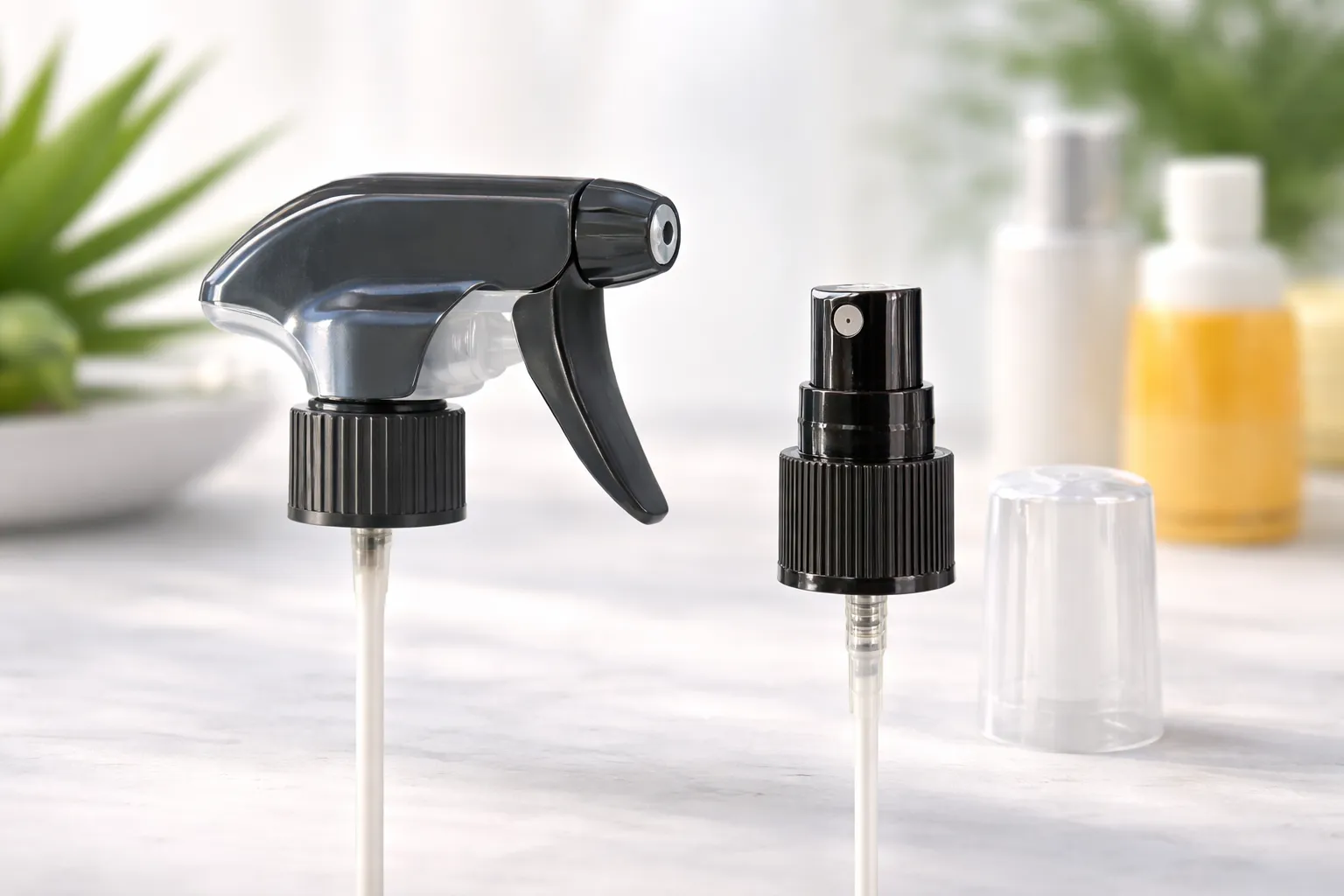
A spray pump is designed for precise, controlled dosing, commonly used in cosmetics and personal care products.
Its main components include:
- Hood – protects the actuator from dust and accidental activation
- Actuator – the pressing element that releases the product
- Collar – secures the pump to the bottle neck
- Spring – ensures controlled return and consistent dosing
- Dip tube – draws the product from the container
Spray pumps are ideal for fine mist applications, such as facial sprays, perfumes, medical solutions or cosmetic liquids.
Key components of a trigger sprayer
A trigger sprayer is designed for larger output and repeated use, often in household, automotive or industrial products.
Its main components include:
- Nozzle – controls spray pattern and flow
- Trigger – allows ergonomic, repeated activation
- Collar – connects the sprayer to the bottle
- Dip tube – transports liquid from the container
Trigger sprayers are commonly used for cleaning products, disinfectants, garden chemicals and professional-use liquids.
Why component knowledge matters in packaging
Choosing between a spray pump and a trigger sprayer is not only about appearance.
The internal construction affects performance, durability and compatibility with different formulations.
Correct selection ensures:
- consistent dispensing
- user comfort
- formula protection
- reduced product waste
Not sure which dispensing solution fits your product?
Contact our team to discuss the right packaging components for your application.